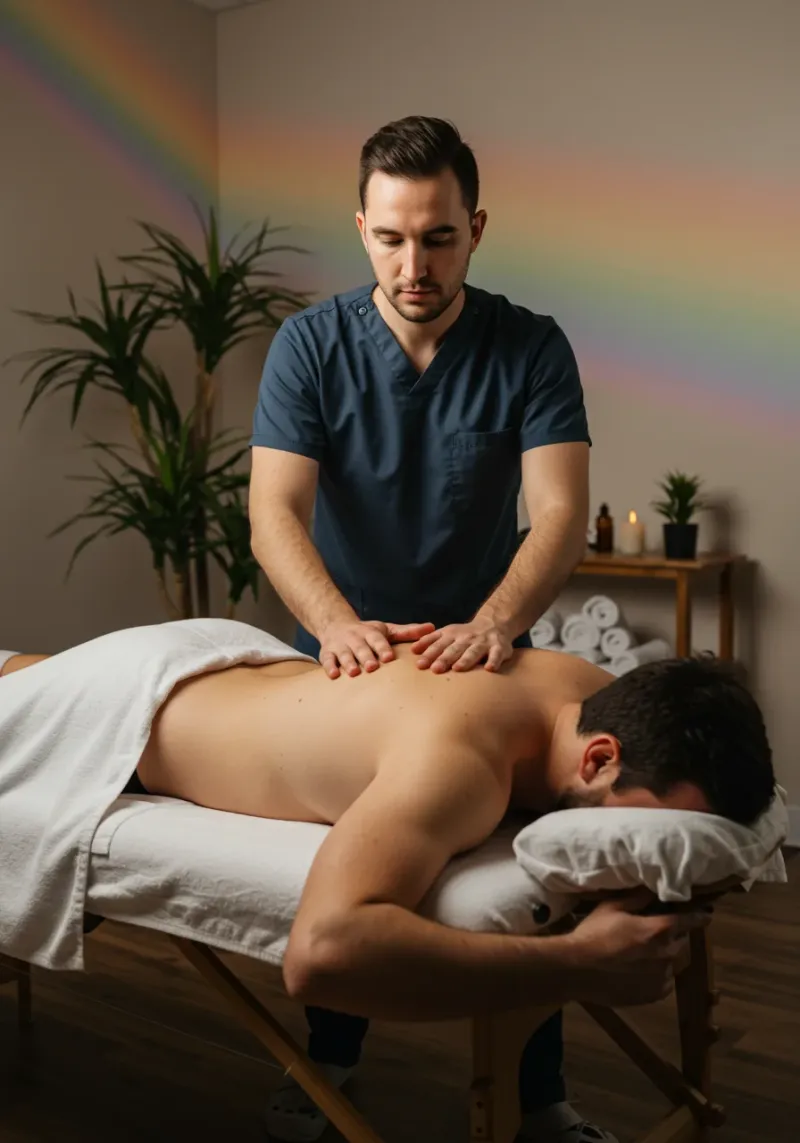
Wired for Survival: How Trauma Lives in Queer Bodies — and How Somatic Healing Can Finally Set It Free

If you've ever walked into a room and immediately scanned for exits, braced yourself before correcting someone who misgendered you, or felt your jaw tighten the second someone clocked you — you already know what a hypervigilant nervous system feels like. You might not have had a name for it. But your body has been tracking threat signals for a long time, probably longer than you realize.
For LGBTQ+ people in the US, this kind of chronic stress isn't occasional. It's ambient. It's the background hum of navigating a world that has historically treated queerness as something to be corrected, hidden, or endured. And while conversations about LGBTQ+ mental health have come a long way, there's still a significant gap when it comes to understanding how that stress doesn't just live in the mind — it lives in the tissue, the breath, the gut, and the spine.
That's exactly where somatic therapy and trauma-informed bodywork come in.
What "Somatic" Actually Means (Without the Jargon)
Somatic is just a fancy word for "relating to the body." Somatic therapy is any approach that treats healing as a full-body process rather than a purely cognitive one. Instead of only talking through your experiences, you're also learning to notice and work with the physical sensations that accompany them — the tightness in your chest when you're anxious, the hollowness in your belly when you dissociate, the way your shoulders creep up toward your ears when you feel unsafe.
Pioneers like Dr. Peter Levine (who developed Somatic Experiencing) and Dr. Bessel van der Kolk, author of The Body Keeps the Score, have spent decades documenting how unresolved trauma gets lodged in the body's stress response system. When the nervous system experiences something overwhelming and doesn't get a chance to fully discharge that activation, it stays stuck in a kind of incomplete loop — oscillating between hyperarousal (fight-or-flight) and hypoarousal (freeze or shutdown).
For queer people, that loop can start shockingly early. Research consistently shows that LGBTQ+ individuals face significantly higher rates of childhood adversity, family rejection, bullying, and community-level discrimination — all of which shape how the nervous system learns to respond to the world.
The Specific Weight That Queer Nervous Systems Carry
Let's be real about what we're actually talking about here. Minority stress — a term coined by researcher Bruce Meyer to describe the excess stress that marginalized groups face due to stigma and discrimination — isn't just psychological. It's physiological. Studies have linked minority stress in LGBTQ+ populations to elevated cortisol levels, disrupted sleep, higher rates of autoimmune conditions, and even structural differences in how the brain processes threat.
Trans and nonbinary individuals often carry an additional layer: gender dysphoria, the experience of medical gatekeeping, and a world that frequently treats their bodies as sites of political debate rather than lived experience. That kind of chronic invalidation has a real neurological cost.
And then there's intergenerational trauma — the way collective experiences like the AIDS crisis, criminalization of queer identity, and decades of forced conversion "therapy" ripple forward through communities, shaping how people relate to their bodies, to healthcare, and to touch itself.
All of this means that queer people often carry tension in specific, patterned ways: chronic bracing in the pelvic floor, shallow chest breathing that never quite reaches the belly, a jaw that's perpetually clenched, or shoulders that haven't fully dropped in years.
Where Trauma-Informed Massage Fits In
Traditional massage therapy can be deeply beneficial — but for people with trauma histories, a standard session can sometimes feel activating rather than relaxing. Being touched by a stranger in a clinical or spa environment, without any acknowledgment of your history or identity, can trigger protective responses that make it hard to actually receive the work.
Trauma-informed massage therapy changes that equation. Practitioners trained in this approach prioritize consent at every stage — not just a signature on an intake form, but ongoing, verbal check-ins throughout the session. They understand the concept of titration (moving slowly, in small doses, to avoid overwhelming the nervous system) and pendulation (helping the client move between states of activation and ease rather than pushing through discomfort).
For LGBTQ+ clients specifically, trauma-informed providers also bring cultural competency to the table. They're not going to assume your anatomy, use gendered language without asking, or make you feel like you need to explain your identity before you can relax. The best practitioners in this space understand that safety isn't just physical — it's relational.
Breathwork: The Fastest Route to Your Nervous System
One of the most accessible somatic tools available doesn't require a practitioner at all: your breath. The diaphragm is directly connected to the vagus nerve — the primary pathway of the parasympathetic nervous system, which governs the body's rest-and-digest state. When you breathe in shallow, rapid patterns (which many anxious people do chronically), you're essentially keeping your nervous system in a low-grade stress response.
Practices like diaphragmatic breathing, box breathing, and extended exhale techniques can help shift the body toward greater regulation. Some LGBTQ+-centered wellness spaces now offer breathwork circles specifically designed for queer and trans participants — which adds the bonus of community, another powerful regulator of the nervous system.
How to Find the Right Practitioner
Finding someone who genuinely gets it — not just someone who slaps a rainbow sticker on their website — takes a little legwork, but it's worth it.
Start with the intake process. A trauma-informed, LGBTQ+-affirming practitioner will have intake forms that include questions about pronouns, preferred names, areas of the body that feel sensitive or off-limits, and trauma history. If those questions aren't there, that's a signal.
Ask direct questions. Don't be afraid to contact a practitioner before booking and ask: Do you have specific training in trauma-informed bodywork? Do you have experience working with LGBTQ+ clients? How they respond will tell you a lot.
Look for specific credentials. Certifications in Somatic Experiencing (SE), Trauma-Sensitive Massage, or training through organizations like the Bodywork Alliance or the National Certification Board for Therapeutic Massage and Bodywork (NCBTMB) are good indicators of serious training.
Tap the community. Queer-centered Facebook groups, local LGBTQ+ centers, and apps like Queer Doc can be great resources for practitioner recommendations from people who've already done the vetting for you.
Trust your gut. If you feel dismissed, rushed, or unseen in a first session, that's information. You don't owe any practitioner a second chance with your nervous system.
The Deeper Point
Healing isn't just about relaxation. For a lot of queer people, it's about reclaiming a relationship with the body that the world spent years trying to sever. Somatic therapy and trauma-informed bodywork aren't luxury services — they're tools for rewiring a stress response that was never the problem to begin with. Your nervous system did exactly what it was supposed to do to keep you safe. Now it gets to learn that safe is possible.
That's not a small thing. That's everything.