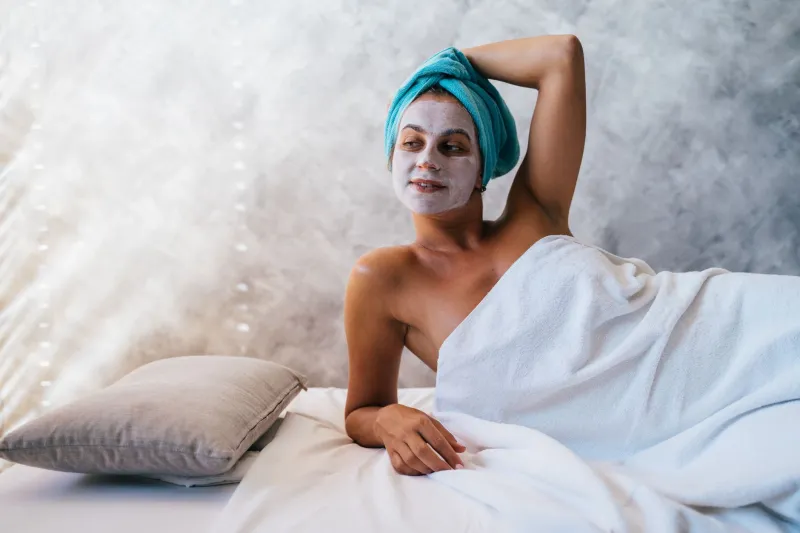
Enjoying Yourself Shouldn't Feel Like a Crime: Unpacking Queer Guilt Around Self-Care

You finally booked the massage. The appointment is set, the day has arrived, and you're lying on a warm table with soft music playing — and somehow, instead of melting into it, your brain is running a quiet but relentless loop. Is this too much? Should I be spending this money somewhere else? Do I even deserve this?
If that sounds familiar, you're not alone. Across the LGBTQ+ community, there's a persistent and largely unspoken tension between knowing that self-care is good for you and actually letting yourself enjoy it without guilt. This isn't just a quirk of personality. It's a pattern — and it has real, traceable roots.
The Setup: Why Pleasure Feels Loaded for Queer People
Let's be honest about something: queer people in America have spent decades being told, in one way or another, that they take up too much space. Whether that messaging came from a religious household, a school that barely acknowledged their existence, a family that tolerated them but never fully affirmed them, or a broader culture that treated LGBTQ+ identity as a problem to be managed — the message was consistent. You are extra. You are a burden. You need to earn your place.
When that's the water you've been swimming in, it makes sense that prioritizing your own pleasure starts to feel transgressive. Self-care requires believing you're worth caring for. And a lot of us are still working on that part.
Internalized homophobia and transphobia play a massive role here. Even people who are proudly, openly queer often carry residual beliefs absorbed during childhood — beliefs that tie shame to their identities in ways that aren't always obvious. You might not consciously think you're less deserving of care. But your nervous system might still be operating on old programming.
The Religious Hangover
For queer Americans who grew up in religious households — and that's a significant portion of the community — pleasure itself was often framed as suspect. Many faith traditions drew hard lines between acceptable comfort and sinful indulgence. Even when those teachings weren't explicitly directed at LGBTQ+ identity, they created a framework where enjoyment required justification. You had to earn rest. You had to deserve softness.
Layered on top of that, many queer people experienced religious communities as sites of rejection or conditional love. When the people who were supposed to model unconditional care made that care contingent on who you were, it leaves a mark. You learn not to expect too much. You learn to make yourself small.
A massage, a spa day, a wellness retreat — these things can trigger that old conditioning without warning. The body remembers even when the conscious mind has moved on.
Money Anxiety and the "Frivolous" Trap
There's also the economic dimension, and it's not small. LGBTQ+ people in the US face documented disparities in income, housing stability, and healthcare access — particularly transgender individuals and queer people of color. When financial stress is a real and ongoing part of your life, spending money on something that feels optional can trigger genuine anxiety.
But here's where it gets tricky: even queer people who are financially comfortable often struggle with this. The guilt isn't always proportional to the actual financial reality. It's more about the cultural messaging that wellness services are frivolous — a luxury for people who have already handled everything else. For communities that have historically had to fight for basic dignity, the idea of prioritizing pleasure can feel almost absurd. Like you haven't earned the right to that level of ease yet.
The truth is, there's no finish line after which self-care becomes appropriate. Wellness isn't a reward for getting your life together. It's part of how you get your life together.
Performing Sacrifice as Identity
Another pattern worth naming: in a lot of queer communities, especially activist-oriented spaces, there's an unspoken culture of martyrdom. The most dedicated people are the ones who push hardest, rest least, and put the collective ahead of themselves. Self-sacrifice gets coded as virtue. Taking care of yourself — especially in ways that feel indulgent — can feel like opting out of the struggle.
This is a real tension, and it deserves real acknowledgment. The queer community has been through a lot. There are ongoing fights for rights, safety, and recognition. It makes sense that people feel pulled toward giving rather than receiving.
But burnout is not a badge of honor. Depletion doesn't make you a better advocate. You cannot pour from an empty cup, and you cannot sustain a movement on a community of exhausted, touch-starved, chronically stressed people. Taking care of yourself is not a retreat from the work. It's what makes the work sustainable.
Reframing the Whole Thing
So how do you actually shift this? A few frameworks that tend to help:
Treat self-care as maintenance, not indulgence. You wouldn't feel guilty about changing the oil in your car or seeing a dentist. Your nervous system, your muscles, your mental health — these also require maintenance. A massage isn't a treat you have to earn. It's upkeep.
Notice the guilt without obeying it. When the guilty thought shows up — this is too much, I don't deserve this — you don't have to argue with it or make it go away. Just notice it. Name it. "There's that old voice again." You get to feel the guilt and stay on the table anyway.
Find practitioners who affirm your presence. This matters more than people realize. When you're receiving care from someone who genuinely sees you and makes you feel welcome — not just tolerated — it becomes easier to receive that care fully. LGBTQ+-affirming wellness providers aren't just a nice-to-have. For a lot of queer people, they're the difference between going through the motions and actually healing.
Connect the dots between your wellness and your community. If the selflessness narrative has a grip on you, try reframing your self-care as a community act. A rested, regulated, cared-for version of you shows up better for the people you love. Your wellbeing ripples outward.
You Don't Have to Justify This
Here's the thing that often gets lost in all the frameworks and reframes: you don't actually need a reason. You don't have to be productive enough, stressed enough, sick enough, or deserving enough to get a massage or take an afternoon for yourself. Pleasure is not a privilege reserved for people who've checked every other box.
Queer people have spent too long waiting for permission to take up space. The wellness industry — at its best — is one of the places where you can practice not waiting anymore. Where you can walk in as you are, lie down, breathe, and let someone take care of you for an hour.
That's not indulgence. That's practice. And the more you do it, the more natural it starts to feel.
You're allowed to feel good. You've always been allowed to feel good. The work is just learning to believe it.